
About Us and Our
Reusable Solutions
At rhinopaq, we reduce packaging waste in B2B shipping by using sturdy, reusable solutions instead of single-use cardboard boxes. With our circular, reusable packaging, companies avoid packaging waste, save on process costs, and reduce their CO₂ emissions from shipping—and the more often a package is reused, the greater the reduction.
The Team

Matthias Thesing
Co-Founder

Marc Diefenbach
Co-Founder
Our Mission
In our world of tomorrow, the single-use cardboard box has been replaced by innovative reusable packaging. We offer a packaging solution designed to safely transport many shipments to customers—one box instead of many single-use cardboard boxes. We are convinced that economic success and climate protection are not mutually exclusive. Quite the contrary—we firmly believe that economic success in the future will only be possible if environmental considerations are taken into account. That is why we are particularly proud that our solution is listed as a “Good Practice” on the European Circular Economy Stakeholder Platform.
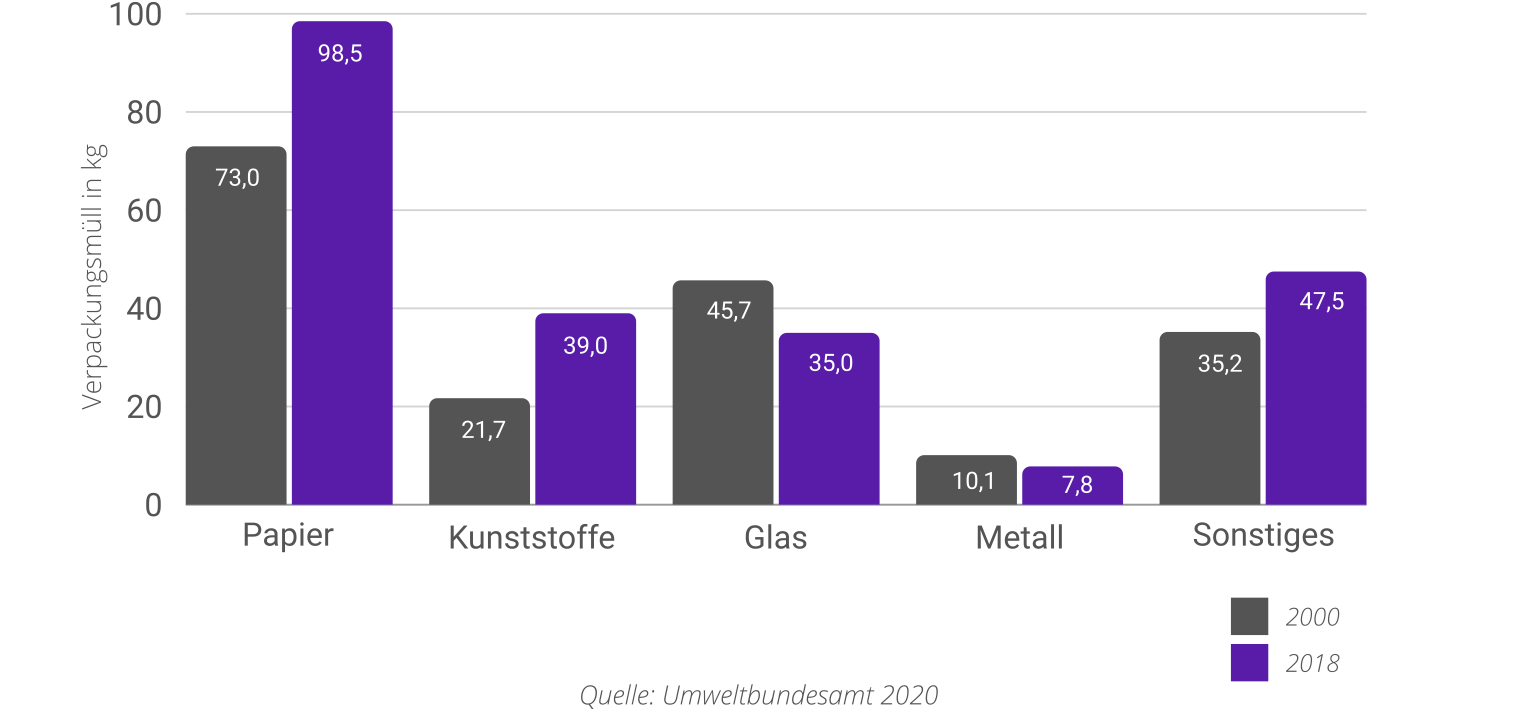
227.5 kg of packaging waste per capita in Germany in 2018
In dialogue with Circular Valley
In conversation with the Circular Valley podcast, we provide insights into our strategic direction. We explain why our reuse systems outperform traditional cardboard after a certain number of cycles—both in terms of carbon footprint and cost efficiency. Social sustainability is particularly important to us: We explain how we organize the reprocessing of our shipping solutions in close cooperation with workshops for people with disabilities and how we’re scaling successful reference projects in spare parts shipping.
In conversation with the Mehrweg Heroes
In this expert discussion with the Mehrweg Heroes, you’ll learn how we’re replacing traditional single-use processes with our circular packaging solutions. We’ll show you how we use integrated tracking (RFID & QR codes) to bring full transparency to the supply chain and automate your inventory management. Find out why we’ve deliberately avoided complex deposit systems to make implementation as easy as possible for you while also improving workplace safety at your receiving locations.
How does the rhinopaq reuse system work?
We sell and rent our reusable packaging solutions to companies that want to join us on the path to a new world of shipping without packaging waste. If your company ships goods, simply use our rhinopaqs instead of single-use cardboard boxes. Your customers will receive all the necessary information in advance about the reusable packaging itself and how it is folded and collected. Your customers can simply drop the packaging into our collection containers. Under the rental model, we then handle the return, processing, and re-delivery. If you decide to purchase reusable packaging, you’ll be responsible for these steps.
How much does reusable packaging cost?
In both the rental and purchase models, prices depend on several factors. These include, of course, the size and choice of materials for the packaging itself, but also the number of uses in the rental model or the number of packaging units in the purchase model. It is therefore difficult to give a general answer. In general, however, it’s safe to say that the packaging itself is of higher quality than single-use packaging and is therefore also more expensive. When broken down by the number of uses of reusable packaging, however, our prices are generally on par with—or even lower than—those of single-use packaging. Feel free to contact us and provide some details about your shipping process. We’d be happy to give you a price estimate based on this information.
How does reusable packaging help?
The concept of reuse significantly reduces the consumption of raw materials, energy, processing, transportation, and landfill waste generated by single-use products. Reuse is referred to as a “circular economy” because, after the raw materials have been processed, the end product is used repeatedly by the same person or by others in the rhinopaq community. As long as we keep the product in circulation and take care of it, it won’t end up in the trash. To achieve many shipping cycles and thereby significantly increase CO2 savings compared to standard single-use packaging, we need a durable material that does not degrade. For our reusable packaging, we therefore rely on polypropylene containing 40 to 60% recycled content.
What is the carbon footprint of the reusable shipping box?
A comparison of the carbon footprints of single-use and reusable packaging shows whether reusable packaging really performs better in product shipping. The following analysis applies to a shipping package measuring 25x25x10 cm. Only those stages of the packaging lifecycle in which the two types differ significantly are considered. Identical stages, such as shipping from the company to the customer, are not included to simplify the analysis.
The key differences are as follows:
- the manufacture or repeated use of reusable packaging
- the return shipment of the reusable packaging
Let’s first consider the manufacturing process. We’re using the CO₂ factors from the “CO2-Faktoren” [CO₂ Factors] information sheet published by the German Federal Funding Program for Energy and Resource Efficiency in the Economy. According to this, the production of 1 kg of cardboard packaging generates 0.62 kg of CO₂ equivalents, meaning a 150-gram cardboard box generates around 93 grams.Show Note 1Values according to the information sheet “CO2-Faktoren” [CO₂ Factors], Version 3.4, from the Federal Funding Program for Energy and Resource Efficiency in the Economy (on behalf of the BMWE), Table 4, p. 16: Cardboard 0.62 and polypropylene (PP) 1.88 metric tons of CO₂ equivalents per metric ton, for manufacturing only.Open the information sheet (PDF) For polypropylene, we use 1.88 kg of CO₂ equivalents per kilogram—conservatively, the value for virgin material. Assuming the same packaging weight, this amounts to 282 grams for the production of one reusable box.
In addition, we assume 10 usage cycles per reusable package; each return generates 36 grams of CO₂. For 10 shipments in single-use boxes, this results in 1.5 kg of paper waste and 0.93 kg of CO₂ equivalents; with reusable packaging, the figures are 0.15 kg of polypropylene waste and 0.64 kg. In this example, this results in CO₂ savings of 31%.
What else do you get out of it?
Another clear advantage of our reusable packaging is its ease of use. While a cardboard box can be a bit of a hassle to assemble, our rhinopaq can be set up and filled in just one step. A second step closes the packaging—just stick on the shipping label, and you’re done. No tape required. This not only reduces waste and costs but also saves handling time.